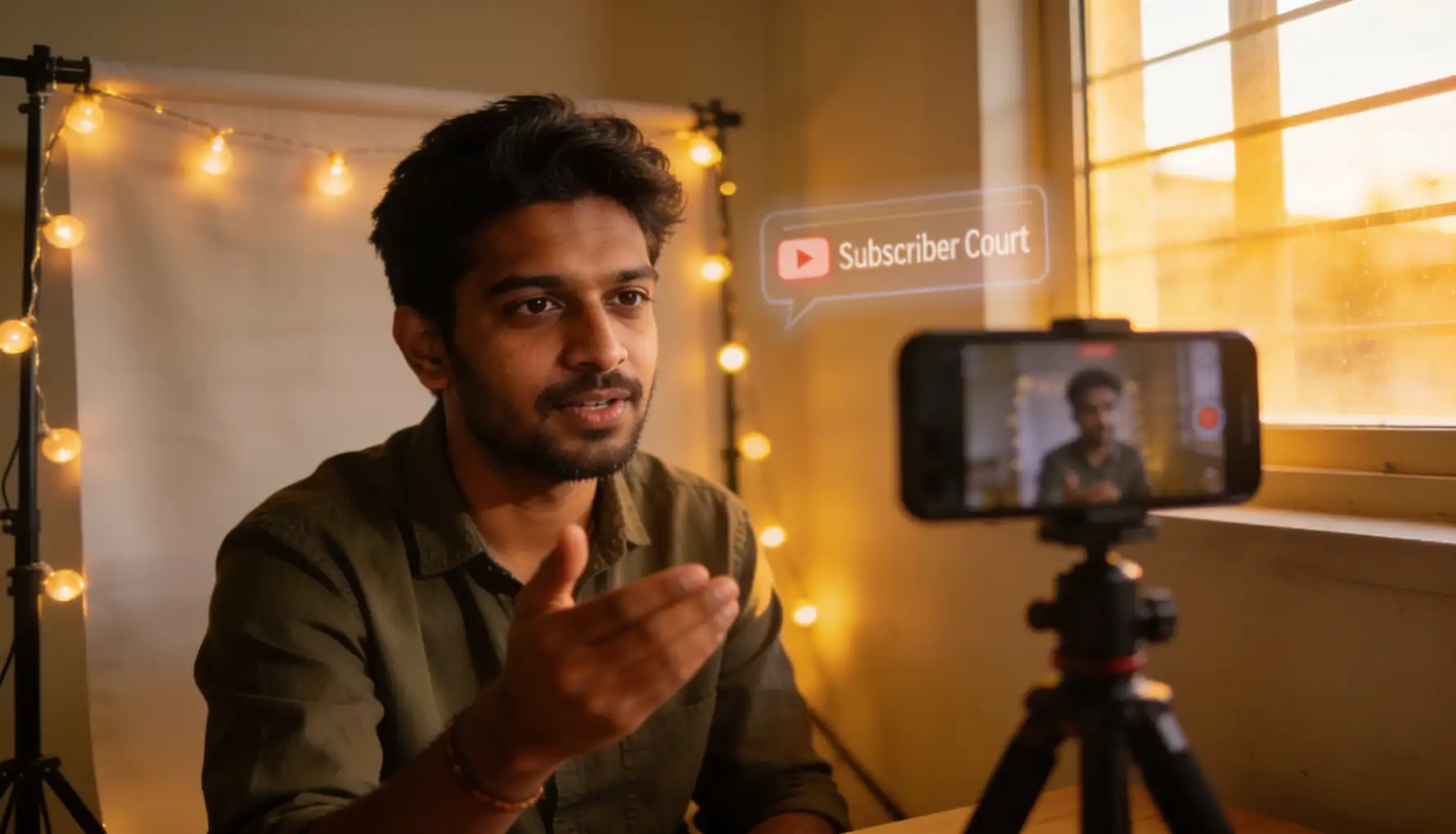
India has more active YouTube channels than almost any country on the planet, and it also has one of the highest concentrations of channels stuck permanently below the 1,000 subscriber threshold — the exact number YouTube requires before a channel can even apply for monetisation. This isn’t a coincidence, and it isn’t simply because Indian creators are competing against each other for the same regional audience. The Indian YouTube landscape has a specific set of structural pressures — language fragmentation, device and connectivity realities, an extraordinarily saturated content market, and monetisation economics that work differently here than almost anywhere else — that make the first 1,000 subscribers a genuinely harder climb for Indian creators than the same milestone represents for creators in most other major markets. Understanding exactly why this happens, and what successful Indian creators are doing differently to break through it, is the difference between a channel that plateaus in its first year and one that finds its footing.
The Scale Problem: Too Many Creators, Too Little Differentiation
India adds new YouTube channels at a rate that few markets can match. The combination of cheap smartphones, inexpensive mobile data following the Jio-driven price collapse of the past decade, and a culture that has rapidly embraced content creation as both hobby and career path has produced one of the most crowded creator markets in the world. This is good news for the platform’s overall health in India and bad news for any individual new creator trying to stand out.
The practical consequence is that competition for any given topic, in any given Indian language, is more intense than the equivalent competition in most other national YouTube markets. A new tech review channel in Hindi isn’t just competing with the dozens of other Hindi tech review channels currently active — it’s competing against established channels with years of audience trust, algorithmic history, and brand relationships that a new entrant simply cannot match in the short term. The same dynamic plays out across cooking, comedy, finance, gaming, vlogging, and virtually every content category that has any commercial viability in the Indian market.
This saturation means that the differentiation bar for a new Indian channel to clear before the algorithm takes notice is considerably higher than it would be in a less crowded market. Generic content in a popular category gets buried instantly. The channels that manage to break through the noise are almost always the ones that found a genuinely specific angle — a regional dialect, an unusually narrow topic focus, a presenter persona distinct enough to be memorable — rather than the ones simply doing a competent version of what dozens of other channels are already doing.
The Language Fragmentation Challenge
India’s linguistic diversity is one of its greatest cultural strengths and one of its most significant structural challenges for new YouTube creators. With more than twenty officially recognised languages and hundreds of dialects, the Indian YouTube audience isn’t a single market — it’s dozens of distinct, partially overlapping markets, each with its own competitive dynamics, content expectations, and algorithmic behaviour.
A creator making content in Hindi has access to the largest single-language audience in the country, but also faces the most intense competition, because Hindi content competes for the attention of creators and viewers across the entire Hindi Belt and beyond. A creator making content in Tamil, Telugu, Bengali, Marathi, or any other regional language has a smaller total addressable audience but typically faces less saturated competition within that specific language community — a trade-off that more new creators should be thinking about deliberately rather than defaulting to Hindi or English simply because those are the most obvious choices.
This fragmentation also affects how YouTube’s recommendation algorithm builds confidence in a new channel. The algorithm needs a meaningful pool of viewers within your specific language and topic combination who watch, engage, and return before it will distribute your content more broadly. In a fragmented language market, that pool can take significantly longer to identify and reach critical evaluation mass than it would in a more linguistically unified market like the US or UK, where a single language serves the overwhelming majority of the platform’s domestic audience.
Connectivity and Device Realities That Shape Viewing Behaviour
A significant proportion of India’s YouTube audience watches primarily on mobile data connections, often with variable speed and reliability outside major metro areas. This shapes viewing behaviour in ways that directly affect how new Indian channels need to think about content format and length.
Indian viewers on constrained data plans or slower connections show measurably different patience for buffering, loading times, and video quality issues than viewers in markets with more universal high-speed broadband access. This has pushed successful Indian creators toward shorter video lengths, lower production overhead that doesn’t compromise on perceived value, and thumbnail and title strategies that communicate value clearly enough to justify the data cost of clicking through, particularly outside the wealthier urban centres where unlimited high-speed data is closer to a given.
New creators who don’t account for this — who produce long-form content with heavy production values better suited to viewers on stable broadband connections — often see retention drop sharply partway through videos, not necessarily because the content itself is weak, but because the viewing experience doesn’t match the conditions a meaningful share of the Indian audience is actually watching under. Retention data, as covered in the broader literature on YouTube growth, is one of the algorithm’s most heavily weighted signals, and an Indian audience watching on a patchy 4G connection in a tier-3 city behaves differently from the same demographic watching on home wifi — a distinction that creators ignoring India’s specific connectivity landscape often miss entirely.
The Monetisation Gap That Changes the Incentive Structure
YouTube’s advertising revenue in India operates at a fundamentally different economic level than in Western markets, and this changes the strategic calculus for Indian creators in ways that affect how they approach the early growth phase.
AdSense CPM rates in India — the amount advertisers pay per thousand views — are typically a fraction of equivalent rates in the US, UK, Canada, or Australia, often in the range of one to three dollars per thousand views compared to five to twenty dollars in those markets. This means that crossing the 1,000 subscriber and 4,000 watch hour threshold required for monetisation eligibility produces a meaningfully smaller initial income for an Indian creator than it would for a creator with an equivalent audience in a higher-CPM market.
The practical consequence is that the first 1,000 subscribers matter even more for Indian creators than the milestone alone would suggest, because the revenue ramp after crossing that threshold is slower and requires higher view volume to reach meaningful income. Many Indian creators who hit the wall below 1,000 subscribers abandon their channels not purely because growth has stalled, but because the economic case for continuing to invest unpaid time becomes harder to sustain when monetisation itself promises modest returns even after the threshold is crossed.
Why Social Proof Hits Differently for Indian Audiences
Subscriber count functions as a credibility signal everywhere, but the effect appears to be particularly pronounced in the Indian context, where collectivist cultural patterns around trust and recommendation amplify the importance of visible social proof before committing attention or trust to new content.
A new visitor browsing Indian YouTube content in any competitive category — finance, education, tech reviews, cooking — encounters dozens of similar options within seconds, and subscriber count functions as one of the fastest available filters for deciding which of those options is worth the time investment. A channel showing 340 subscribers competing against established channels with hundreds of thousands creates an immediate, almost unconscious deprioritisation in the viewer’s decision process, regardless of the actual content quality difference between the two.
This dynamic is compounded by India’s strong word-of-mouth and recommendation culture — content already validated by visible audience numbers is more likely to be shared within family and friend networks, generating organic distribution that doesn’t depend on YouTube’s algorithm at all. A channel that’s already crossed a credible subscriber threshold benefits from this informal recommendation economy in ways a channel stuck in the low hundreds simply cannot access.
Many Indian creators address this directly by using services to buy YouTube subscribers to push their channel past the visible credibility threshold faster, recognising that the gap between a three-digit and four-digit subscriber count changes how new visitors evaluate the channel before they’ve watched a single second of content. This is particularly relevant in India’s intensely competitive content categories, where the difference between a channel that gets a chance and one that gets scrolled past is often decided in the first half-second a viewer spends looking at the channel name and subscriber count alongside a search result or recommendation thumbnail.
What’s Actually Working for Indian Creators Breaking Through
Despite all of these structural headwinds, Indian creators do break through the first 1,000 subscriber barrier every day, and the patterns among those who succeed are consistent enough to extract genuine strategic lessons.
Niche specificity within a regional language consistently outperforms broad content in a crowded language like Hindi or English. A finance channel specifically for first-generation investors in Tier-2 Indian cities, explained in conversational Hindi with region-specific examples, faces dramatically less competition than a generic personal finance channel competing against India’s largest established finance creators. The same logic applies across categories — specificity is a more reliable growth lever in the Indian market precisely because the broad categories are so thoroughly saturated already.
Cross-platform funnelling from Instagram Reels and WhatsApp sharing has become a particularly important growth channel for Indian creators, reflecting both the popularity of these platforms in India and the strong cultural tendency toward sharing content within family and community WhatsApp groups. A short, shareable clip forwarded through Indian WhatsApp networks can drive a meaningful spike in channel discovery that wouldn’t have happened through YouTube’s own discovery mechanisms alone.
Consistency through the difficult early phase matters more in the Indian context specifically because the credibility threshold viewers apply is higher in such a saturated market. Channels that post inconsistently during their first months — pausing for weeks at a time, restarting, changing format repeatedly — send weak signals both to the algorithm and to any viewers who do discover the channel during this period, compounding the difficulty of an already harder growth environment. The Indian creators who break through most reliably are disproportionately the ones who maintained a steady, predictable upload schedule through the entire period before reaching meaningful subscriber numbers, even when early metrics gave them little encouragement to continue.
Building a Strategy Around India’s Specific Conditions
The most effective approach for new Indian creators treats the market’s specific structural conditions as planning inputs rather than obstacles to ignore or wish away. This means choosing language and niche combinations deliberately based on competitive density rather than simply defaulting to the most obvious choice; designing content formats and lengths that account for the real connectivity conditions a meaningful share of the target audience experiences; planning for a longer and more economically challenging monetisation runway than creators in higher-CPM markets face; and building the social proof and credibility signals that India’s particularly intense word-of-mouth and trust-driven content culture rewards disproportionately.
For creators serious about navigating this specific landscape, combining a deliberate content and niche strategy with YouTube growth services for Indian creators that understand these market-specific dynamics — rather than generic growth advice imported wholesale from US or European creator playbooks — produces meaningfully better outcomes than either approach alone. The structural challenges facing Indian YouTube creators are real and significant, but they are also well understood by the creators and growth specialists who have spent years navigating exactly this market, and that accumulated understanding is a genuine strategic advantage available to any new creator willing to learn from it rather than relearning every lesson independently through trial and error.
For channels in the critical early phase where view velocity on new content directly affects whether YouTube’s algorithm gives a video any meaningful evaluation window at all, services that grow YouTube channel India creators rely on to seed early view momentum can be the difference between a video that gets a genuine chance at algorithmic distribution and one that disappears into the enormous volume of daily uploads competing for the same Indian audience attention. Used alongside genuinely strong, specific, audience-appropriate content, this kind of early momentum investment addresses the exact cold-start problem that makes the first 1,000 subscribers disproportionately difficult in a market as saturated and structurally demanding as India’s.
The first 1,000 subscribers is hard everywhere. In India, it’s harder still, for reasons that are specific, structural, and largely outside any individual creator’s control. But understanding exactly why that’s true is the first step toward building a strategy that accounts for it rather than one that quietly assumes Indian YouTube works the same way as the markets where most generic growth advice was written.
Related Posts