Picture a precision component sitting on a workbench after final inspection.
It looks perfect.
The measurements are correct, the paperwork is complete, and the order is ready to go. Maybe the part took weeks to manufacture. Maybe it is one small piece of a much larger defense system.
Now comes the part people sometimes underestimate: getting it to its destination in the same condition.
That is the job of military packaging.
Military Packaging helps defense contractors, government suppliers, aerospace manufacturers, machine shops, and industrial companies protect equipment throughout transportation and storage. As a go-to source for military packaging supplies, Military Packaging provides MIL-SPEC packaging materials, military specification boxes, ASTM D5118 boxes, W5C boxes and V3C boxes, desiccants, Fast Packs, protective wraps, films, bags, tubing, barrier materials, wooden crates, and custom military packaging solutions.
Because manufacturing the product correctly is only half the battle. It still has to survive the trip.
The Journey Starts at the Packaging Station
Professional military packaging begins by evaluating the product and the hazards it may encounter.
Packaging personnel should consider the item’s dimensions, weight, fragility, material composition, surface condition, and environmental sensitivity. Transportation methods and expected storage conditions may also influence material selection.
From there, an appropriate packaging system can be developed.
For one product, that might mean protective wrapping and a military specification box.
Another item may require cushioning, desiccants, and barrier packaging.
A large piece of equipment may require a custom wooden crate with blocking and bracing.
There is no universal military package because there is no universal military product.
Then the Package Leaves Your Building
This is where things get interesting.
Inside your facility, everything is controlled. Your employees know what they’re handling. The floor is smooth. The product isn’t traveling 500 miles in the back of a truck.
Once the shipment leaves, you lose much of that control.
The package gets loaded.
Then unloaded.
Then moved again.
It may sit in a distribution center. It might be stacked with other shipments. Eventually, it gets loaded onto another vehicle and starts the next part of its journey.
A military package needs to be ready for that reality.
Choosing the Right Military Specification Box
The exterior container provides the structural foundation of many military packaging systems.
Military specification boxes can differ from ordinary commercial cartons in construction, strength, materials, and intended performance.
Depending on the requirement, buyers may need ASTM D5118 boxes, W5C boxes, V3C boxes, weather-resistant corrugated boxes, or other military shipping containers.
The correct choice depends on the product and applicable requirements.
Military Packaging provides military boxes for defense contractors and manufacturers that need dependable corrugated packaging for government and military shipments.
For recurring programs, having access to consistent box specifications can also make packaging operations much easier to standardize.
Somewhere Along the Way, Humidity Shows Up
Maybe the shipment leaves a dry facility in Southern California.
Then it travels somewhere humid.
Or maybe it sits in storage where temperature and humidity fluctuate.
The exterior box still looks great. No crushed corners. No water stains.
Everything must be fine, right?
Not necessarily.
Moisture doesn’t need to destroy the box to damage what’s inside.
Metal components can corrode. Sensitive equipment can deteriorate. Long-term storage can make small moisture problems more significant.
That is why military preservation packaging often includes materials specifically intended to help manage environmental exposure.
Desiccants and Barrier Packaging
Desiccants can help absorb moisture inside properly prepared packaging systems.
Flexible barrier materials can help reduce exposure to the surrounding environment. When combined appropriately, these products can provide an additional level of protection for moisture-sensitive equipment.
The preservation method should always reflect the product and applicable packaging requirements.
For precision components, metal assemblies, electronics, aerospace parts, and other sensitive equipment, moisture protection may be just as important as protection against physical impact.
Military Packaging supplies desiccants, barrier bags, flexible packaging materials, and related military packaging supplies for these applications.
A Little Protective Paper Can Go a Long Way
Not every packaging solution needs to look complicated.
Take creped chemically neutral wrap.
It looks simple, but it performs an important job. The material creates a protective layer around components while its creped construction makes it easier to conform around unusual shapes.
That makes it useful for machined parts, metal components, assemblies, and sensitive surfaces.
The wrap can be used with other military packaging products, including poly bags, cushioning, desiccants, barrier materials, and corrugated containers.
Military Packaging supplies creped neutral wrap for military, aerospace, government, and industrial packaging operations.
Now the Truck Starts Moving
A truck doesn’t travel like a warehouse shelf.
It vibrates.
It hits bumps.
It accelerates, brakes, turns, and travels across roads that are definitely not all smooth.
If the product has too much room to move inside the package, those forces can become a problem.
Cushioning, blocking, bracing, and appropriate container sizing help control movement and reduce the forces reaching the product.
For smaller components, military Fast Packs offer a convenient option.
Fast Packs combine an exterior container with interior cushioning, providing standardized protection for many smaller sensitive products.
Small Parts Still Deserve Serious Packaging
It’s easy to look at a small component and think it doesn’t require much packaging.
But size and importance are two different things.
A small electronic module could be expensive. A replacement part could be holding up maintenance on a much larger system. A precision component could take weeks to manufacture again.
Military Fast Packs can help protect these smaller products against shock and handling hazards.
They also make life easier for packaging teams that regularly handle similar components.
Instead of developing a custom package every time, a standardized Fast Pack may provide a practical solution.
Military Packaging offers Fast Packs alongside other military packaging supplies for small and medium-sized components.
Flexible Packaging Keeps Everything Organized
Poly bags, films, and tubing are the workhorses that rarely get much attention.
They help keep individual components separated, clean, and protected.
Tubing is particularly convenient when parts vary in length because packaging personnel can create appropriately sized sleeves. Films provide additional wrapping and covering options, while barrier bags can offer increased environmental protection when required.
These materials can be used inside larger military boxes and crates or as components of more complex preservation systems.
Military Packaging provides flexible packaging materials in addition to rigid military shipping containers.
What Happens When the Product Weighs Hundreds of Pounds?
Then the box conversation changes completely.
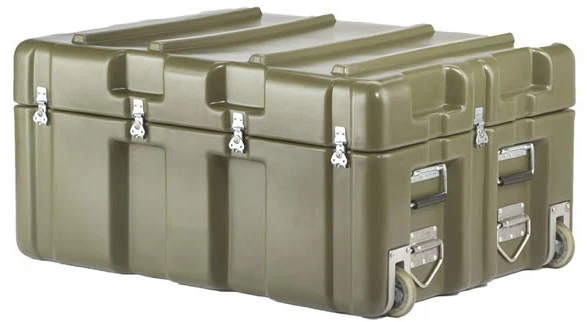
Large machinery, vehicle components, aerospace assemblies, industrial equipment, and oversized defense products may require custom wooden crates.
A properly designed crate can provide structural support while controlling how the equipment moves during transportation.
Blocking and bracing can hold the product in position. Interior supports can help distribute weight. Cushioning can protect vulnerable areas.
If environmental protection is required, the crate can become part of a larger preservation system involving barrier materials and desiccants.
Military Packaging can provide custom military crates for large, heavy, sensitive, and high-value equipment.
Eventually, the Shipment Arrives
This is the moment that matters.
Someone opens the package.
The component should look the way it did when it passed final inspection.
No rust.
No cracked components.
No damaged surfaces.
No equipment bouncing around loose inside the container.
No surprise phone call back to the manufacturer.
When that happens, the packaging has done its job.
And that’s really the point.
One Source for Military Packaging Supplies
The defense supply chain includes businesses of every size.
Large contractors, aerospace manufacturers, machine shops, electronics companies, metal fabricators, logistics providers, government vendors, and subcontractors may all encounter specialized military packaging requirements.
Military Packaging gives those organizations a dedicated source for the products they need.
Instead of searching across multiple suppliers for boxes, wraps, desiccants, bags, Fast Packs, and crates, customers can consolidate more of their military packaging requirements with one company.
That simplifies procurement and helps companies establish a reliable source for recurring programs.
Make Military Packaging Your Go-To Source
Every shipment has a journey.
Some are short and simple. Others cross thousands of miles, move through multiple warehouses, experience changing environments, and sit in storage before anyone opens them.
You cannot control everything that happens along the way.
But you can control how the product is packaged before it leaves.
Military Packaging provides MIL-SPEC packaging materials, military specification boxes, ASTM D5118 boxes, W5C boxes, V3C boxes, military Fast Packs, desiccants, creped neutral wrap, barrier packaging, poly bags, films, tubing, wooden crates, and custom military packaging solutions.
For defense contractors, government suppliers, manufacturers, aerospace companies, and industrial organizations, Military Packaging is ready to become the go-to source for military packaging supplies.
Protect the product. Prepare for the journey. Package it right the first time.
Related Posts