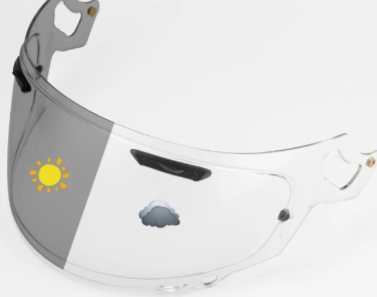
A ride that starts in bright morning sun and finishes in dusk, tree cover or a tunnel can turn a perfectly good visor into the wrong one. The usual fix is a clear shield in the tank bag and a dark one on the helmet, plus a roadside swap whenever the light changes. Plenty of Arai owners would like to stop doing that.
The trouble is that the answer isn’t one product. Arai fits different shields across its sport, adventure and open-face helmets, and the options range from aftermarket light-reactive visors to anti-fog lenses to Arai’s own tinted parts. Buying before you know which helmet you have is how people end up with a shield that doesn’t fit.
This guide works through four questions in order: your exact model, how you want the tint to behave, your anti-fog needs, and your budget.
Start With the Label: Matching Visor to Helmet
Start with the label inside your helmet. Arai sells the same helmet under different names in different markets, so a model name you saw in a forum or a shop listing may not match the one printed on yours. Read the label, write down the exact name, and use that name for every search from here on.
This matters because Arai doesn’t use one shield across its range. Fit follows the helmet family. Sport helmets such as the RX-7V and RX-7X, adventure helmets such as the Tour-X5, XD-5 and Tour-Cross V, and open-face helmets such as the VZ-Ram, RAM-X and SZ-R each take different parts. One family’s visor won’t suit another’s, however similar the tint looks in a photo.
Once you have your model name, check an arai photochromic visor compatibility list before ordering. That page comes from a retailer that sells the visors it covers, so treat it as a starting point and confirm fit on the product page of whatever you buy. It groups aftermarket options by helmet family, which makes it quick to see whether your model is covered at all.
If your model doesn’t appear, don’t assume a near neighbour will fit. Go back to the label and the seller’s stated fit.
Does Arai Make Its Own Auto-Tint Option?
The question does arai make a photochromic visor comes up often, and the answer depends on what Arai’s parts catalog lists. On Arai’s US parts site, the check this guide draws on found two kinds of official shield: fixed tinted shields and the Pro Shade System. It did not find a shield that tints by itself.
The fixed options are what they sound like. One example in that check is the VAS-A MAX-V shield in a semi tint, listed for the XD-5. A fixed tint stays the same whatever the light does, so it suits a ride where conditions are predictable more than one that moves between bright and dim.
The Pro Shade System, listed for helmets that take a VAS shield, is Arai’s own answer to changing light. It is not described in the source as self-changing, so don’t treat it as an auto-tint shield or assume it behaves like one. Read the product page and confirm what it does before ordering.
Two caveats apply. The check was made on 10 November 2026 and reflects a single look at the catalog, so Arai may have added or changed parts since. The source is also a seller of aftermarket visors. Look at Arai’s parts listings yourself before ruling anything in or out.
Third-Party Routes for RX-7V Owners
RX-7V owners have two third-party routes. The first is an aftermarket replacement visor. ClearLineMoto lists a photochromic visor for the RX-7V and RX-7X at $85.99, in stock when checked on 10 November 2026. That is an aftermarket part, not an Arai one, and ClearLineMoto sells it, so treat its own page as a retailer’s description rather than independent confirmation of fit or performance. RX-7V owners comparing options will find a full side-by-side of the best photochromic shield for arai rx-7v candidates there.
The second route is Pinlock’s PrecisionTone lens. It is listed for the RX-7V visor with Arai-specific pins, and the source pitches it for riders who want anti-fog and a changing tint in one part. Pinlock’s page showed no price, and independent confirmation of fit and tint behavior is still missing, so verify both with Pinlock before ordering.
The trade-off is roughly this. A replacement visor swaps the whole shield, and its price is visible up front. A Pinlock lens is a different kind of part, and you would be relying on the pin fit and an unconfirmed price.
You may also see “Quantic” in listings. I couldn’t confirm it is a market name for the RX-7V, so check the label inside your helmet first. If you want to buy arai photochromic visor rx7v quantic listings, confirm stock and fit on the product page.
Pricing, Anti-Fog and Adding Auto-Tint to Other Arai Models
Prices shift, so check a current arai vas-v transition shield price against the alternatives. The VAS-V listing in question is Arai’s own Pro Shade System, and the source did not find it to be self-changing. As of 10 November 2026, that part was listed at 101.95 USD on Arai’s US parts site. The aftermarket RX-7V photochromic visor from ClearLineMoto, which also sells the visors in the source table, was listed at 85.99 USD. Pinlock showed no price for its RX-7V lens. These figures come from one check and may have changed.
Other families have aftermarket options too. The same source lists a Tour-X5, XD-5 and Tour-Cross V visor at 85.99 USD, and a VZ-Ram, RAM-X and SZ-R visor at 67.99 USD, both dated 10 November 2026. Match the part to your helmet’s exact model name, not just its category.
If you ride in cold or wet weather, confirm that the visor takes an anti-fog insert before you order. For a model-by-model view of how to add auto tint visor to arai helmet owners can follow the fit guidance, but confirm fit independently on the product page.
Conclusion
Choosing a visor for changing light comes down to four questions, asked in order. First, confirm your exact model from the label inside the helmet, since names vary by market. Second, decide whether you want the tint to change on its own or are happy with a fixed tint or Arai’s Pro Shade System. Third, check that the visor works with an anti-fog insert if you ride in cold or wet weather. Only then compare budgets, remembering that prices change and that aftermarket and Arai parts are different things.
Related Posts