
When riverbanks overflow, civil defense teams must act quickly to stop floodwater from reaching residential neighborhoods, hospitals, transport routes, water-treatment facilities, and municipal power stations. Even a short delay can allow water to spread through streets, damage electrical equipment, contaminate drinking-water systems, and force large-scale evacuations.
Flood-response plans therefore need containment systems that can be transported easily, installed rapidly, and expanded as conditions change. Conventional sandbag walls remain useful for small entry points and localized protection, but they are often too slow for defending long stretches of vulnerable land. Modern geotextile-lined barriers give emergency authorities a faster and more practical alternative.
Why Traditional Sandbag Walls Can Fall Short
Sandbags have been used in flood emergencies for generations. They are familiar, inexpensive at the individual-unit level, and easy to place around doors, drains, and low openings. However, their limitations become clear during major flood events.
Building a large sandbag wall requires a steady supply of bags, sand, filling equipment, transport vehicles, and volunteers. Thousands of bags may be needed to protect only a short section of riverbank or roadway. Each bag must be filled, carried, positioned, and compacted properly. When crews are working in rain, darkness, mud, or rapidly rising water, construction becomes slower and more dangerous.
Sandbag walls are also vulnerable to gaps, uneven settlement, erosion, and seepage. Water can travel through poorly compacted areas or wash away material around the base. Once the wall begins to weaken, repairing it under active flood conditions becomes difficult.
For large-scale protection, civil defense agencies increasingly rely on modular geotextile barriers that can be installed with mechanical equipment and filled using locally available material.
How Geotextile Flood Barriers Work
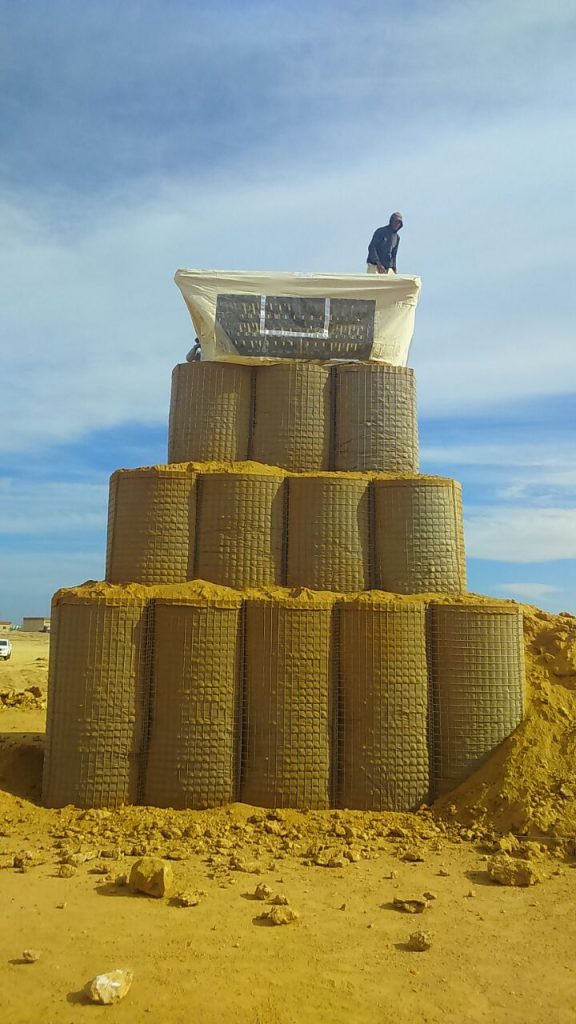
A modern flood-control barrier normally consists of collapsible wire-mesh cells lined with strong geotextile fabric. The connected cells are unfolded at the deployment site and filled with sand, soil, gravel, or another suitable material.
The steel mesh provides the barrier’s external shape and structural support. The geotextile liner holds the fill material inside while preventing it from escaping through the mesh openings. Together, these components create a dense wall capable of resisting water pressure, floating debris, erosion, and minor impact forces.
A heavy-duty hesco barrier system can be delivered in compact, folded sections and expanded when needed. A small crew supported by a front-end loader, excavator, or similar machine can establish a high-volume containment wall much faster than a comparable sandbag structure.
The cells can be positioned in a straight line, curved around vulnerable infrastructure, stacked for additional height, or arranged in multiple rows for greater stability. This flexibility makes the system suitable for riverbanks, drainage channels, substations, emergency shelters, fuel-storage areas, and temporary access roads.
Rapid Deployment During Flood Emergencies
Speed is one of the strongest advantages of geotextile barriers. During flash floods or sudden river surges, authorities may have only a few hours to prepare. A system that reduces manual handling can make the difference between protecting an area and losing it.
Deployment usually begins with a site assessment. Civil defense engineers identify the expected direction of water movement, the height of the projected flood level, the condition of the ground, and the infrastructure requiring protection. Crews then clear major debris, level the installation path where possible, and unfold the barrier units.
Mechanical equipment fills each cell with suitable material. Because several connected cells can be filled in sequence, the wall grows quickly. Additional sections can be attached as the protected perimeter expands.
This process requires fewer personnel than sandbag construction. It also reduces worker fatigue and limits the amount of time responders spend close to rising water. The saved manpower can be redirected toward evacuation support, medical assistance, traffic control, pumping operations, and public communication.
Protecting Residential Areas and Critical Infrastructure
Flood defenses must often protect more than homes. Municipal power stations, electrical substations, telecommunications facilities, hospitals, water-treatment plants, pumping stations, and emergency command centers are all vulnerable to water damage.
A power substation, for example, may occupy a relatively small footprint but serve thousands of residents. Constructing a protective wall around it can prevent a localized flood from becoming a wider electrical emergency. Similar barriers can be placed around backup generators, fuel tanks, control rooms, and equipment yards.
In residential districts, geotextile barriers can be installed along low roads, drainage canals, riverside parks, and neighborhood boundaries. They may also be used to redirect water toward safer overflow areas rather than attempting to block it completely.
The best results come from combining barriers with pumps, drainage controls, water-level monitoring, evacuation routes, and clear emergency communications. No single barrier can eliminate every flood risk, but a well-planned containment system can slow water movement and give residents more time to evacuate.
Controlled Drainage and Structural Stability
The inner geotextile lining performs an important role beyond retaining soil. It helps prevent fine fill material from washing through the steel mesh while allowing limited moisture movement. This can reduce internal pressure and lower the risk of sudden structural washout.
However, the barrier must still be installed on suitable ground. Soft soil, loose debris, steep slopes, and fast-moving water can affect stability. Engineers may need to widen the base, use multiple rows, add anchoring measures, or place erosion-control material around the structure.
Fill quality also matters. Extremely wet soil may settle more than compacted sand or gravel. Large stones can damage the liner if dropped carelessly. The selected material should be compatible with the barrier design, expected water pressure, deployment duration, and available equipment.
Routine inspection is necessary throughout the emergency. Crews should watch for settlement, leaning sections, erosion around the base, damaged mesh, overflowing water, or debris accumulation. Small problems are easier to correct before they affect the entire wall.
Understanding Barrier Costs
Municipal planners should evaluate flood barriers based on total operational cost rather than purchase price alone. Initial expenses may include the barrier units, transportation, storage, handling equipment, training, inspection, and replacement materials.
The quoted hesco barrier price may vary depending on unit dimensions, wire thickness, mesh specifications, geotextile grade, coating type, order quantity, shipping distance, and custom manufacturing requirements. Larger systems designed for deeper water or long-term exposure will generally require a higher investment than smaller emergency units.
Labor savings can offset part of that cost. A system installed by a small trained crew and a loader may replace the work of a much larger volunteer force. Faster deployment can also reduce property losses, infrastructure downtime, road closures, and emergency accommodation expenses.
Reusable components may provide additional value when they can be emptied, inspected, repaired, and stored after the flood. Reuse depends on the condition of the mesh, fabric liner, connectors, and fill material, so authorities should follow supplier guidance before redeploying used units.
Storage and Emergency Preparedness
Flood-control barriers are most effective when they are already included in a municipal disaster plan. Attempting to source large quantities after a flood warning has been issued may lead to transport delays, limited stock, or higher emergency purchasing costs.
Civil defense agencies should store barrier units in dry, accessible warehouses near high-risk regions. Storage sites should also contain lifting equipment, connectors, repair tools, personal protective equipment, lighting, pumps, warning signs, and deployment instructions.
Local operators must be trained before an emergency. Training exercises can show teams how to unfold the units, connect sections, choose suitable fill, operate loaders safely, and inspect completed walls. Practice also helps planners estimate how many personnel and machines are required for different flood scenarios.
Emergency warehouses should maintain clear inventory records. Each barrier unit should be inspected periodically for corrosion, fabric deterioration, damaged connectors, or improper folding. Access routes to storage facilities must remain usable during storms.
Securing Flood-Affected Areas
Flood response involves more than stopping water. Authorities must also control vehicle movement, protect damaged infrastructure, keep residents away from unstable structures, and create safe working areas for emergency crews.
Portable temporary fence systems can be stored alongside flood-control barriers and deployed around evacuation centers, damaged roads, electrical hazards, equipment yards, and restricted cleanup zones.
Temporary fencing helps guide pedestrians and vehicles without requiring permanent construction. Panels can be repositioned as water levels fall and recovery operations move from one location to another. Warning signs, lighting, and reflective markings should be added where barriers are used near roads or during nighttime operations.
Security planning becomes especially important when residents have evacuated. Empty neighborhoods, damaged commercial properties, fuel-storage areas, and relief-supply depots may require controlled access. A combination of temporary fencing, staffed checkpoints, lighting, and patrols can reduce unauthorized entry while allowing emergency personnel to move efficiently.
Environmental and Cleanup Considerations
Once floodwater recedes, authorities must remove or repurpose the barrier system safely. The fill material may have been exposed to sewage, fuel, chemicals, animal waste, or contaminated sediment. It should not automatically be returned to parks, farms, or construction projects without assessment.
Crews should test or classify the material when contamination is suspected. Clean soil may be reused in approved locations, while contaminated material may require regulated disposal.
The geotextile liner and steel mesh should also be inspected. Damaged fabric can release fill during dismantling, and bent mesh may create sharp edges. Workers should wear suitable gloves, boots, protective clothing, and respiratory protection where contaminated dust is present.
A post-emergency review should document how the barriers performed. Planners should record installation time, labor requirements, equipment availability, structural problems, water levels, damaged units, and areas where additional protection was needed. These findings can improve future purchasing and deployment decisions.
Building a Layered Civil Defense Strategy
Geotextile flood barriers work best as part of a layered defense system. Permanent levees, drainage improvements, retention basins, pumps, raised electrical equipment, flood-resistant building design, early-warning systems, and evacuation planning all contribute to community resilience.
Modular barriers provide the flexible element in that system. They can reinforce a weak riverbank, protect a temporary construction site, surround a critical facility, close a gap in a permanent levee, or redirect water away from populated areas.
Municipalities should map potential deployment locations before flood season. Each location should include estimated wall length, required height, ground conditions, access for heavy equipment, available fill material, and nearby hazards. Preplanned routes allow crews to respond without losing time to on-site decision-making.
Procurement teams should also confirm that barriers meet the required structural, coating, fabric, and dimensional specifications. Buying solely on price may result in units that are unsuitable for the expected flood conditions.
Conclusion
Flood emergencies place enormous pressure on local authorities. Rising water leaves little time for slow construction methods, complicated supply chains, or large-scale manual labor.
Geotextile-lined barriers give civil defense teams a practical way to create strong, adaptable flood defenses with fewer workers and faster installation. Their modular design supports long walls, curved layouts, stacked protection, and rapid reinforcement of vulnerable infrastructure.
The strongest emergency plans combine these barriers with trained operators, suitable machinery, secure storage, portable fencing, pumps, monitoring systems, and predetermined deployment sites. Municipal planners must also account for inspection, contamination, dismantling, and material disposal after the emergency has passed.
A barrier is only one part of flood readiness, but when it is positioned correctly and deployed early, it can protect essential services, reduce property damage, and create valuable time for evacuation and recovery operations.