The modern supply chain moves at a blistering pace. Driven by the demands of e-commerce and next-day delivery expectations, warehouses and distribution centers are under immense pressure to process, pick, and ship inventory faster than ever before.
Facility managers often invest heavily in automated conveyor systems, advanced inventory tracking software, and modern forklifts to shave seconds off their processing times. Yet, one of the most critical elements of warehouse efficiency is frequently overlooked: how the human workforce communicates. When a barcode won’t scan, a forklift breaks down, or a loading dock is double-booked, the speed at which that problem is resolved dictates the efficiency of the entire shift. Here is why instant Push-to-Talk (PTT) communication remains the undisputed king of warehouse logistics.
1. The Bottleneck of Bad Communication
Many modern facilities make the mistake of relying on employee smartphones or outdated overhead Public Address (PA) systems. Both have severe limitations in an industrial setting.
Smartphones are fragile, distracting, and require cellular or Wi-Fi networks that notoriously struggle to penetrate the thick concrete walls and towering metal racks of a warehouse. Furthermore, unlocking a phone, finding a contact, and waiting for it to ring takes time.
PA systems, on the other hand, contribute to “alarm fatigue.” Blaring a message across a 100,000-square-foot facility to reach one specific forklift driver is disruptive to everyone else and often gets drowned out by the ambient noise of machinery.
2. The Push-to-Talk (PTT) Advantage
In logistics, seconds matter. Push-to-Talk technology eliminates dialing, ringing, and waiting. A floor manager can press a button and instantly broadcast a message to the entire loading dock team, or switch channels to speak privately with a specific supervisor.
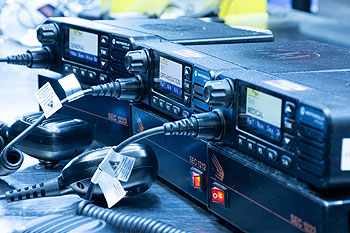
For heavy equipment operators, mounting rugged mobile two-way radios inside forklifts and pallet jacks is a game-changer. It allows drivers to receive instructions without taking their eyes off their surroundings or fumbling with a fragile device, drastically reducing downtime between tasks.
3. Safety in High-Traffic Zones
Warehouses are inherently hazardous environments. Forklifts, automated guided vehicles (AGVs), and pedestrian workers constantly share tight aisles and blind corners.
Instant communication is a critical safety tool. If a spill occurs in aisle 4, a worker can instantly radio the floor, preventing a forklift from speeding around the corner and causing a major accident. Modern digital radios also feature noise-canceling technology, ensuring that even over the roar of a loading dock, voice commands are heard clearly the first time.
4. Seamless Fleet and Floor Coordination
Today’s digital PTT devices (like the Motorola MotoTRBO series) do much more than transmit voice. They can integrate into a broader digital ecosystem, offering features like GPS tracking, text messaging, and direct integration with facility security systems.
However, outfitting a facility requires more than just buying devices off the shelf. Warehouse managers need to consider dead zones, FCC/CRTC licensing for frequencies, and the durability of the equipment. Partnering with communication specialists like Production Radios ensures that a facility is equipped with the right repeaters and digital infrastructure to guarantee 100% coverage, from the basement inventory racks to the outdoor shipping yard.
The Bottom Line
Upgrading warehouse software or machinery will only get you so far if your team cannot effectively coordinate their efforts. By replacing slow, fragile communication methods with rugged, instant Push-to-Talk systems, warehouse managers can eliminate dead time, drastically improve floor safety, and ensure their facility operates like a well-oiled machine.
Related Posts